
E-Commerce Shipping
Canada-to-US Shipping Changes 2026: Tariffs & CPSC Rules
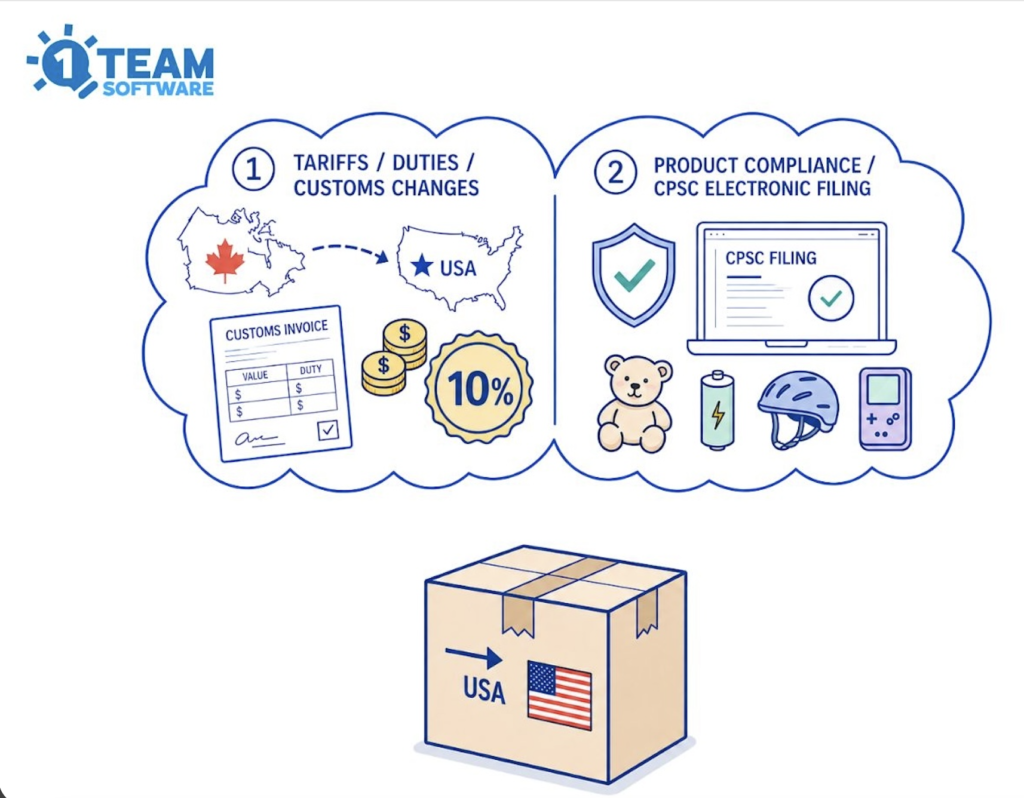
If you sell from Canada into the US, the rulebook you used last year is already out of date. Two separate changes are landing within a couple of weeks of each other this summer. One is about money: duties and tariffs. The other is about paperwork: product-safety certificates. Get either one wrong, and your parcels can sit at the border, pick up new fees, or get turned away outright.
The part that’s easy to miss is that these come from two different US agencies and solve two different problems. So plenty of sellers hear about one and get blindsided by the other. Below is the plain version of what changed, what customs actually wants from you now, and what Chit Chats and Stallion have already built to keep your packages moving. We build the WooCommerce shipping plugins for both carriers, so we’ve been reading these updates line by line.
The 60-second version:
- Tariffs (July 24, 2026): the blanket Section 122 tariff goes away, and Section 301 duties now apply to every country of origin. Canadian-made goods pick up an extra 10% duty.
- Product safety (in effect July 8, 2026): the CPSC now wants Certificate of Compliance data filed electronically at the time of import for regulated consumer goods.
- Clean data is no longer optional. You need accurate descriptions, a valid 10-digit HTS code, and real country-of-origin info. “N/A” gets you flagged.
- Both platforms have already shipped fixes: CUSMA registration, HAZMAT flagging, validation at label creation, and broker-side CPSC filing.
Why this matters right now
Canada-to-US is one of the busiest shipping lanes anywhere, and most small sellers are running on thin margins. A 10% duty swing or a held shipment isn’t a rounding error. It’s the gap between a profitable order and a refund. That alone makes it worth twenty minutes to get this right before your next batch of labels.
The two changes are easier to handle separately, because lumping them together is how sellers miss half the picture.
Change #1: the tariff shake-up (effective July 24, 2026)
Here’s what actually happens on July 24. The US drops the blanket Section 122 tariff and expands Section 301 to cover every country of origin, not just China the way it used to. For goods made in Canada, that means an extra 10% duty on top of whatever else already applies.
Up to now, Section 301 was mostly a China story. That’s over. The framework is broad now, and each origin country carries its own rate.
The new duty rates at a glance
| Origin of goods | Additional duty under the new structure |
|---|---|
| Canada | +10% |
| All other countries (general) | +12.5% |
| Brazil (Section 301, eff. July 22) | 25% |
| China (Section 301, by HTS code) | 7.5% to 25% |
One thing trips people up here. The duty follows where the goods were made, not where they ship from. Import your inventory into a Canadian warehouse and mail it south, and it can still owe the higher origin-based rate. That’s why the country-of-origin field on your labels suddenly carries real money.
How to cut the tariff on Canadian goods: CUSMA
If your products are genuinely made in Canada, the US, or Mexico and they meet the CUSMA Rules of Origin, they can qualify for duty-free or reduced treatment. A CUSMA certification lasts one year. For most Canadian sellers, this is the single biggest lever you have to protect your margins, so it’s the first thing to check.
Two more tariff-adjacent changes worth knowing
Starting July 12, 2026, USPS adds a $3 non-compliance fee on any package over 1 cubic foot or longer than 22 inches when the size or weight you declared doesn’t match the actual parcel. For now it only hits oversized packages, but in early 2027 it spreads to every shipment, whatever the size. So measure carefully.
There’s also a HAZMAT piece: as of July 7, 2026, you’re expected to flag any hazardous-materials contents on-platform before it ships.
Change #2: the CPSC eFiling mandate (in effect July 8, 2026)
This one isn’t a tariff at all, which is exactly why it slips past people. Now the US Consumer Product Safety Commission wants your Certificate of Compliance data filed electronically, through the Automated Commercial Environment (ACE), right when regulated consumer products are imported. The rule amends 16 CFR Part 1110.
Different agency, different problem, same border headache if you ignore it. And it lands on a lot of the same sellers the tariff change does.
What products are affected?
Toys, children’s clothing and furniture, bicycles, helmets, button-cell batteries, mattresses, carpets and rugs, ATVs, imitation jewelry, and a range of household goods and consumer electronics. If you sell any of those into the US, this is for you.
Which certificate do you need?
| Product type | Certificate | Testing standard |
|---|---|---|
| Children’s products (ages 12 and under) | Children’s Product Certificate (CPC) | Third-party testing at a CPSC-accredited lab |
| General-use regulated products | General Certificate of Conformity (GCC) | First-party testing through a reasonable testing program may qualify |
Whichever one you need, it has to spell out the standards you’re certifying against, your latest test date, every lab you used, and any exclusions you’re leaning on. As of July 8, 2026, it also has to include component-part test results.
The dates that matter
- Now through July 7, 2026: voluntary registration and test filings in the CPSC Product Registry, capped at the first 2,000 participants. No HTS-code flagging yet.
- July 8, 2026: mandatory eFiling starts, and CPSC begins flagging HTS codes in ACE.
- January 8, 2027: the requirement extends to products imported through Foreign Trade Zones.
Skip it, and you’re looking at customs delays, extra inspections, or refusal of entry. Same pain as a tariff mistake, just triggered by missing paperwork instead of an unpaid duty.
What every Canada-to-US shipment now needs: clean customs data
Tariff or certificate, it all comes back to the same thing. Customs now leans on the data you type when you create the label. Both platforms flagged the same short list of non-negotiables:
- A specific product description. “Cotton t-shirt,” not “t-shirt.”
- A valid 10-digit HTS code on every item.
- Manufacturer info that actually matches the country of origin.
- No placeholders. “Unknown,” “N/A,” or a blank field will get the shipment flagged.
The honest way to think about it: accurate data is the new postage. Skip it, and the label doesn’t really work.
What Stallion Express has done about it
Stallion has focused on the CPSC side and the customs-broker plumbing behind it. In their update, they say the team is “already testing solutions with our broker for submitting CPSC data and disclaimers through the Stallion platform.” In practice that means they’re:
- Checking customers’ HTS codes against the CPSC-flagged list so you know early whether you’re affected.
- Walking sellers through what each certificate needs: CPC versus GCC, test dates, labs, and any exclusions.
- Advising on the filing options, specifically Full PGA versus Reference PGA.
- Lining up timelines with their broker so filings happen at the right point in the import flow.
- Building the actual submission into the platform, so you’re not filing CPSC data and disclaimers off on your own. WooCommerce sellers can connect those labels and rates through our Stallion Express Shipping PRO plugin.
What Chit Chats has done about it
Chit Chats has leaned into the tariff side and data quality. Their updates so far:
- CUSMA registration right inside your account, so you can claim duty-free or reduced treatment on qualifying North-American-made goods. If you’re on WooCommerce, our Chit Chats Shipping PRO plugin pulls those live rates into checkout.
- A CUSMA renewal workflow in the works, with details expected around July 2026, since the certification only lasts a year.
- HAZMAT identification on the platform as of July 7, 2026.
- Validation at postage creation that catches missing information before you buy the label, which is a lot cheaper than finding out at the border.
- A fallback for incomplete data: Chit Chats International Tracked, for shipments that can’t supply full manufacturer info.
How each carrier is handling the 2026 changes
| Area | Chit Chats | Stallion Express |
|---|---|---|
| Main focus of their update | Tariffs, duties, data quality | CPSC product-safety eFiling |
| CUSMA duty relief | In-account registration + renewal workflow | Advises within customs workflow |
| CPSC certificate filing | Validation to prevent flags | Broker-side submission being built |
| HAZMAT handling | On-platform ID (Jul 7) | Not addressed in their update |
| Data-quality safeguards | Missing-info checks at label creation | HTS-code review vs. CPSC flag list |
| Fallback option | Chit Chats Intl Tracked | Full vs. Reference PGA guidance |
This snapshot is about compliance only. For a full carrier comparison: rates, coverage, speed, see our [Chit Chats vs Stallion Express guide]
Your six-step checklist before the next shipment
- Put a real 10-digit HTS code on every product. Guessing is what triggers flags in the first place.
- Confirm the true country of origin for each SKU. Where it was made, not where it ships from.
- Check whether you qualify for CUSMA. If your goods are North-American-made, register and certify to cut the duty, and put the one-year renewal in your calendar now.
- Find your CPSC-regulated items and pull together the right certificate, CPC or GCC, plus component-part test results.
- Kill every placeholder. Swap “N/A” and vague descriptions for specific, accurate details.
- Measure and weigh honestly to dodge the USPS $3 fee, and remember it applies to all package sizes come early 2027.
Frequently asked questions
When do the new Canada-to-US tariffs take effect?
July 24, 2026. That’s when Section 122 is removed, and Section 301 expands. From that date, Canadian-origin goods carry an additional 10% duty on top of any other applicable duties.
What is the CPSC eFiling requirement?
It’s a US Consumer Product Safety Commission rule, in effect July 8, 2026. It requires Certificate of Compliance data to be filed electronically through ACE when regulated consumer products are imported. Think toys, children’s products, batteries, and electronics.
How can I avoid the extra 10% duty on Canadian goods?
If your products meet the CUSMA Rules of Origin (made in Canada, the US, or Mexico), you can register for CUSMA treatment and qualify for duty-free or reduced duties. The certification is good for one year.
Why do descriptions and HTS codes suddenly matter so much?
Because customs now uses the data you enter to calculate duties and check compliance automatically. Vague descriptions, missing HTS codes, or placeholder text can cause delays, inspections, or refusal of entry.
What’s the USPS $3 fee about?
From July 12, 2026, USPS charges a $3 non-compliance fee on packages over 1 cubic foot or longer than 22 inches when the declared dimensions or weight don’t match. In early 2027, it applies to all package sizes.
Do the new US tariffs apply to everything I ship from Canada?
No, they key off each item’s country of origin, not the country you ship from. Canadian-made goods face the +10% Section 301 duty, but items made elsewhere and warehoused in Canada may carry a different origin-based rate. Goods that meet the CUSMA Rules of Origin may qualify for duty-free treatment.
Do I need a 10-digit HTS code to ship from Canada to the US?
Yes. Both Chit Chats and Stallion Express now expect a valid 10-digit HTS code, an accurate description, and correct country-of-origin data on every shipment. Missing codes or placeholder text like “N/A” can trigger delays, inspections, or refusal of entry.
Which products need a CPSC Children’s Product Certificate (CPC)?
Anything designed mainly for children 12 and under: toys, children’s clothing and furniture, bicycles, helmets, and so on. A CPC has to be backed by third-party testing at a CPSC-accredited lab. General-use regulated products use a General Certificate of Conformity (GCC) instead.
How do Chit Chats and Stallion differ on the 2026 compliance changes?
They’re built around different halves of the change. Chit Chats is stronger on tariffs and duty relief with built-in CUSMA registration and validation. Stallion Express is stronger on CPSC product-safety eFiling with broker-side submission. Sell regulated consumer goods, and you’ll probably use both. For an overall comparison beyond compliance, see our [Chit Chats vs Stallion Express guide]
The bottom line
Two changes, one takeaway: the border is a data checkpoint now. Tariffs decide what you owe. CPSC filing decides whether your product is even allowed in. And both get enforced through the information you type when you make a label.
The platforms have done their part. Chit Chats built CUSMA registration and validation to protect your duty exposure and catch bad data early. Stallion built broker-side CPSC filing so your compliance paperwork rides along with the shipment. The rest is on you: feed them clean, accurate data and most of this stops being a problem.
Shipping Canada-to-US from WooCommerce?
Make sure your store hands complete product data (HTS codes, country of origin, real descriptions) straight to Chit Chats and Stallion at checkout, so every label is compliant from the start.
Take a look at our ChitChats Shipping PRO for WooCommerce and Stallion Express Shipping PRO for WooCommerce, or browse all our multi-carrier shipping plugins to compare live rates from 50+ carriers at checkout.
Sources: Stallion Express, US CPSC Compliance Rule for Imported Consumer Products and Chit Chats, U.S. Shipping Updates and Tariffs. Dates and rates reflect what each carrier published and may be updated by the issuing agencies, so confirm the current requirements before you ship.